
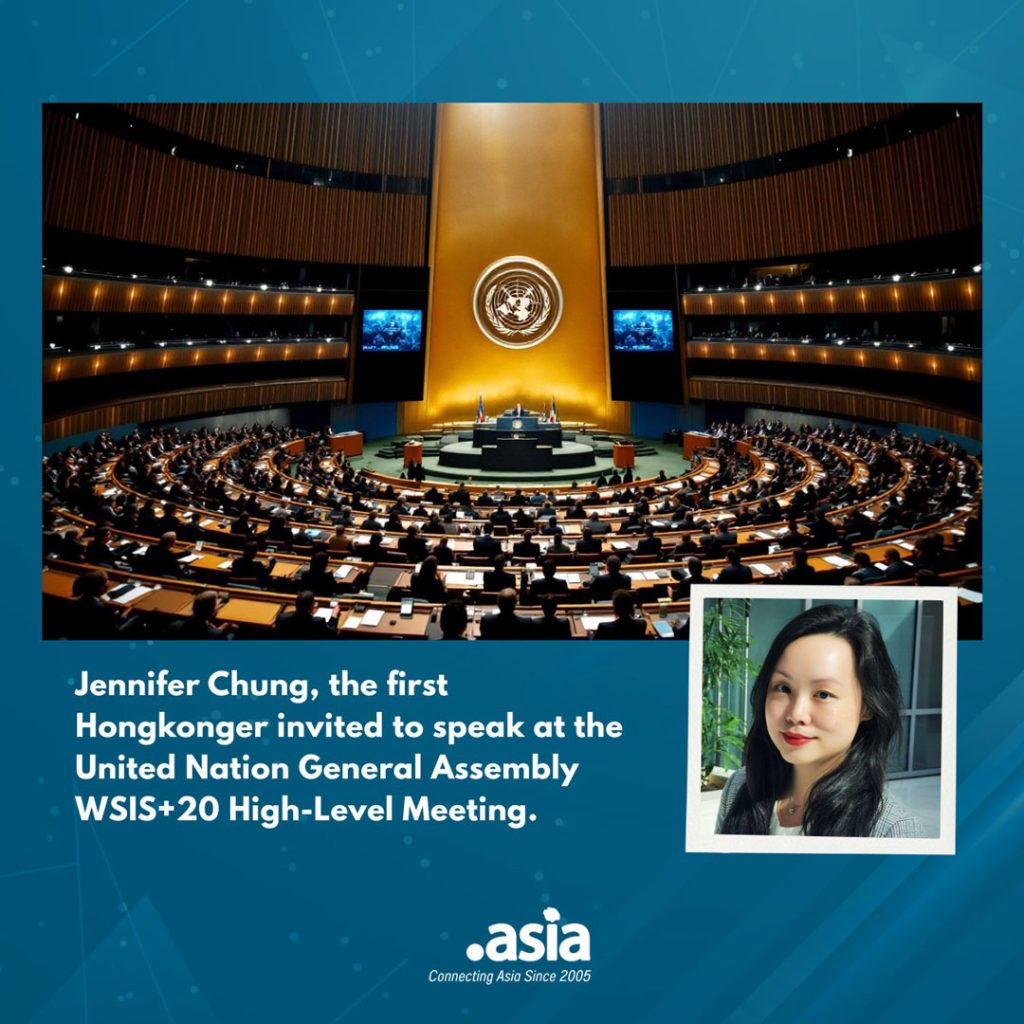
Jennifer Chung, the first Hongkoner invited to speak at the United Nation General Assembly WSIS+20 High-Level Meeting
On 17 December 2025, Jennifer Chung, VP for Policy Development at DotAsia and Co-Convenor of the Informal Multistakeholder Sounding Board (IMSB), became the first Hongkonger to address the United Nations (U.N.) at the General Assembly WSIS+20 High-Level Meeting. This was a milestone moment not only for DotAsia and Hong Kong, but the entire multistakeholder model of Internet Governance.
2025 was a critical year for Internet Governance. In 2025, the 20-year review of the World Summit on the Information Society (WSIS+20), a United Nations-led process to assess the effectiveness of using Information and Communication Technologies (ICTs) for development since 2005, took place. In addition to DotAsia’s engagement and Jennifer Chung’s leadership on the IMSB, NetMission.Asia, the longest standing youth Internet Governance program in the world, significantly mobilized Asia Pacific (APAC) Youth stakeholder inputs in the WSIS+20 Review process. This review helped define the UN’s future actions in digital development, including how different stakeholders will be involved.
In the years ahead, the outcomes of WSIS+20 will continue to be critical.
Significant Outcomes
In her remarks, Jennifer Chung highlighted the importance of the multistakeholder approach in shaping an inclusive and collaborative digital future, and the need for continued cooperation across sectors, regions, and communities. Watch Jennifer’s full remarks here. These remarks are reflected in the significant outcomes of the WSIS+20 Review process.
Youth. Throughout the review process, the Informal Multistakeholder Sounding Board (IMSB) convened multiple rounds of virtual stakeholder consultations, inviting all stakeholders to provide targeted, paragraph-based comments on successive revisions of the outcome document. Youth representatives from the Asia Pacific (APAC) region actively contributed to the WSIS+20 Review process throughout 2025. As a result of their engagement, Youth are now explicitly recognized as a stakeholder in the core multistakeholder framework (Para 3).
The inclusion of youth in the WSIS+20 Outcome Document was a direct result of consistent APAC Youth consultations during 2025. This multi-round engagement demonstrates youth capacity to contribute substantively to global governance processes and shape commitments that will guide digital cooperation for years to come.
Asia Pacific (APAC) closing the digital divide. The APAC region led as engaged contributors throughout 2025 consultations, and as part of the “Global South” at the U.N., negotiating the WSIS+20 Outcome Document. Asia is experiencing the largest Internet growth globally—driven by rapid digital transformation, technological advancements, increasing digital infrastructure investments, and a large youth population now coming online. As such, its participation was integral to shaping the WSIS+20 Outcome Document.
Permanent Internet Governance Forum (IGF). At the United Nations, the “G77+China” emphasized the importance of closing the digital divide. For context, the Group of 77 (G77) is the largest intergovernmental coalition of developing nations at the U.N., formed in 1964 to promote collective economic interests and increase joint negotiating power. It now includes 134 members from Asia, Africa and Latin America, united under the banner of the “Global South” for shared goals in development, trade, and global governance reform, with China participating as a key partner but not a full member. The U.N., including G77+China, ultimately resolved the Internet Governance Forum’s status will be permanent (Para 99), providing institutional stability that benefits youth participation.
Artificial intelligence. Significantly, the importance of the multistakeholder model was not only affirmed for collaboration on Internet Governance, but for collaboration on artificial intelligence (AI) (Para 85). The U.N. resolved that “We will leverage existing United Nations and multi-stakeholder mechanisms” to address the challenges and opportunities inherent in artificial intelligence technologies.
The Implementation Road Ahead
“Access is not enough. What are we going to do with it? How are we going to uplift and empower the communities to be able to have this digital transformation, have the digital impact we want to see across the board?”
The WSIS+20 Outcome Document commits the global stakeholder community to maintaining an open, accessible and interoperable Internet, based on the multistakeholder model of Internet Governance. It also states that “effective participation, partnership and cooperation of Government, the private sector, civil society, international organisations, the technical communities and all other relevant stakeholders including youth” will continue to be vital to achieve the goals of WSIS. This recognition is critical as Asia, and the global community, enters the next phase of digital cooperation.
In 2026 and beyond, there will be significant discussion on next steps for implementation of these outcomes, yet action will be more significant. While the multistakeholder model is recognized as vital in achieving the goals of WSIS, it requires continuous improvement. While the G77+China and the Global South significantly shaped the WSIS+20 Outcome Document, invigorating government participation in APAC for IGF is crucial in representing the voices of the world’s fastest growing region.
As Jennifer Chung described in a January 2026 Asia Pacific Regional Internet Governance Forum (APrIGF) WSIS+20 Working Group webinar discussing next steps, “Access is not enough. What are we going to do with it? How are we going to uplift and empower the communities to be able to have this digital transformation, have the digital impact we want to see across the board?”
What’s Next?
You can determine what is next for the future of the Internet. To find out about the latest developments about the WSIS+20 overall review by the United Nations General Assembly, please refer to this page. To engage in the Asia Pacific Regional Internet Governance Forum (APrIGF), check out the WSIS+20 Review webinar and APrIGF website. To engage in Internet Governance for APAC Youth, join NetMission.