
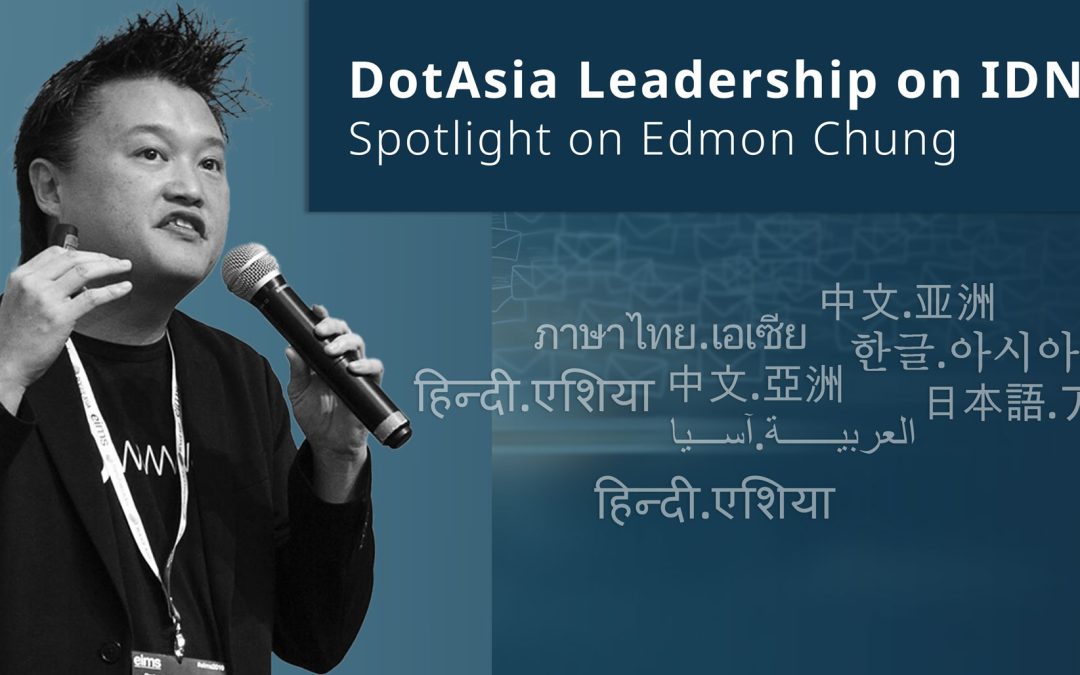
A Universal Acceptance (UA) Expert Working Group (EWG) at the Internet Corporation for Assigned Names and Numbers (ICANN) is tasked with proposing guidelines related to UA adoption. On 26 August, the UAEWG announced its membership for those with demonstrated knowledge of Universal Acceptance (UA) and Internationalized Domain Names (IDNs), experience in multilingual Internet, and related expertise. Edmon Chung, CEO of DotAsia and a pioneer of IDNs, was appointed to the UAEWG as its Co-Chair.
Read on to learn more about DotAsia’s leadership role on this important topic.
IDNs support young people in expressing their identity in their native language online, UA ensures that the Internet’s core protocols can be upgraded to become more inclusive and secure, and a Multilingual Internet is an important equalizer for the linguistically marginalized, bright minds of the future.
What are IDNs?
Related to IDNs, Universal Acceptance (UA) ensures that all valid domain names and related email addresses, regardless of length, language, or script, can be used in Internet-enabled applications, devices, and systems. In a UA-ready world, Internet users can choose an online identity in the language or script of their choice, and ensure that their chosen domain names and email addresses work seamlessly on the Internet. Achieving UA-readiness is essential to enabling a more linguistically diverse Internet.
The .Asia (DotAsia) TLD supports IDNs in several Asian scripts—including Han (Chinese), Japanese, and Hangul (Korean), allowing registrants to use their local language in domain names. UA and IDNs are also an important component of the ICANN New gTLD Program: Next Round, which will expand competition, innovation, and consumer choice in the Domain Name System (DNS). DotAsia is a Mentor in the ICANN Applicant Support Program (ASP), which is intended to make the New Generic Top-Level Domains (gTLD) Program: Next Round application and evaluation processes and fees more accessible to nonprofits and other entities that would like to operate a registry but would otherwise be unable to apply, because of financial and resource constraints.
Edmon Chung is a recognized pioneer and advocate for IDNs and UA, and has been integral to the deployment of IDNs on DotAsia and on other domains. He is an inventor of patents underlying technologies for IDNs and email addresses on the Internet. Edmon previously served in various leadership roles related to Internet Governance, UA and IDNs, including as Chair of the ICANN Board IDN/UA Working Group, Co-Chair of the ICANN Joint Country Code Names Supporting Organization (ccNSO)/Generic Names Supporting Organization (GNSO) IDN Working Group (JIG), which contributed to the advancement of Universal Acceptance (UA) in the ICANN community, and served as a member of many global technical and policy committees that enabled the introduction of multilingual domain names and email addresses.
Spotlight on Edmon Chung
Why is it important for ICANN to take a multistakeholder approach on IDNs?
A multistakeholder approach to the development and implementation of policies and standards on the Internet as a global resource is crucial for maintaining an Internet we love. The technical community has completed the work on standards, and together with the linguistic community has ensured the secure and stable implementation of IDNs. ICANN plays a pivotal role in bringing together the different stakeholders to make UA of IDNs a reality. Government policies, corporate roadmaps, technical platform upgrades, updates to university networking 101 courses to include IDN (and IPv6 for that matter), as well as civil society movements for language justice, are all important components to realize UA for IDNs.
Why is the issue of IDNs important to DotAsia, and the Asia Pacific region in general? Are there kinds of IDNs more prevalent in the region?
Asia is home to a significant portion of the world’s linguistic diversity. It is also experiencing the largest Internet growth globally— driven by rapid digital transformation, technological advancements, increasing digital infrastructure investments, and a large youth population now coming online. For youth and the elderly alike, a Multilingual Internet makes for a safer Internet simply because one can better discern a potential phishing domain in their own native language. The first thing any cybersecurity course would advise users to do is to check the email address and domain name before you click.
Universal Acceptance of IDNs enhances trust for the Domain Name System (DNS) which continues to be the core addressing infrastructure for the Internet. Every app, search, and artificial intelligence (AI)-generated prompt response relies on multiple domain names to locate resources and facilitate navigation through the Internet. The Multilingual Internet requires IDNs, and IDNs drive local language content, which in turn enriches data for machine learning to avoid linguistic and cultural bias in AI models. It is a linguistic cycle, beginning with IDNs and UA, that will support a diverse Internet for the Asia Pacific communities and prevent the homogenizing effect of globalization.
Why are IDNs important to you personally? And what do the youth want to see on the topic in terms of Internet Governance (IG)?
My mother tongue is Cantonese and I am proud of it being one of the oldest languages and among the top languages natively spoken in the world. Yet Cantonese is facing marginalization by the dominant Mandarin dialect. I believe linguistic diversity is important for a world that treasures knowledge and human development because every language opens a different window and perspective to see the world. Languages are becoming extinct as globalization advances, the Internet and AI are forces for hegemonic progression, and IDNs are an important counterforce against an English-first Internet. Multilingualism, IDNs and UA by-design are the foundation for an Internet that drives progress without forsaking an enriching environment and historical context for humanity to thrive and enjoy into the future. That is why I believe IDNs are important.
I am not young anymore, but I am reminded by the youth I have the privilege to work with through the NetMission program which DotAsia supports, that there should be “nothing for the youth without the youth.” Youth-led approaches to research, policy development and implementation should become an important component within any multistakeholder governance system. IDNs support young people in expressing their identity in their native language online, UA ensures that the Internet’s core protocols can be upgraded to become more inclusive and secure, and a Multilingual Internet is an important equalizer for the linguistically marginalized, bright minds of the future. I am excited to see the NetMission youth network taking on IDNs and UA advocacy alongside digital rights, addressing DNS Abuse, and other Internet governance issues.
The Age of Digital Interdependence, a report from the High-level Panel on Digital Cooperation
The report of the “UN Secretary-General’s High-level Panel on Digital Cooperation” was published earlier this month, and contains both a set of considerations and a list of actionable items broken down into the following categories: “An Inclusive Digital Economy and...

A promising start for our NetMission Ambassadors!
Our Hong Kong based Ambassadors had the opportunity to plunge straight into the hot topics buzzing around Internet Governance. The 2nd Hong Kong Internet Governance Forum Roundtable hosted by Internet Society HK with support from the Hon. Charles Mok’s office at...

Kids4Kids Sharing For A Cause 2019: Donate Children’s Picture Storybooks
Aiming to develop social awareness and responsibility by providing platforms that empower kids to enact positive change in their community, Kids4Kids is hosting its 9th annual Sharing for a Cause (SFAC) campaign and DotAsia Organisation is proud to be one of the...

Looking ahead to APrIGF and IGF Berlin
Have you heard of the city that sits on the easternmost terminus of the Trans Siberian railway? Vladivostok is the city that bears the honor. Situated in the Golden Horn Bay in the Russian Far East, it is the location for the 10th edition of the Asia Pacific Regional...