
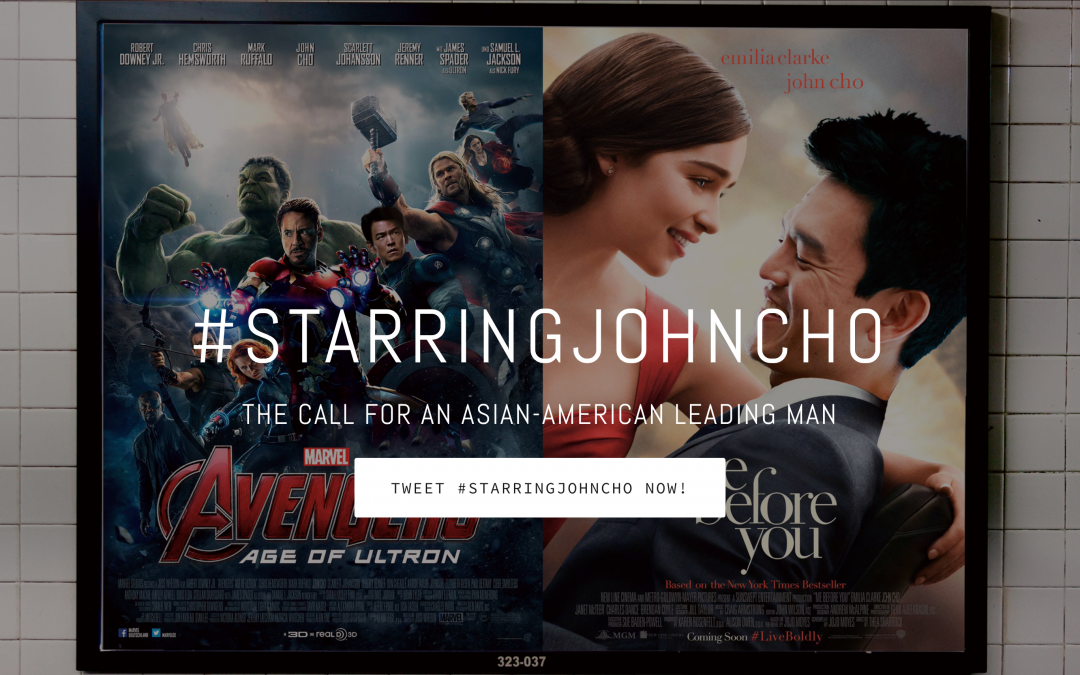
(Image credits: #StarringJohnCho images and movie mockups originate from http://starringjohncho.com/)
With 2018 being a banner year for Asian representation in media, 2019 is gearing up to be a blockbuster sequel. Promoting inclusion and representation in mainstream media is a job that is never really finished. For decades Asian-American actors and actresses have worked hard to gain the opportunities in front of the camera that is now giving rise to the more realistic portrayals of Asian-Americans in television and films. However, equal representation is still a far ways off. In the past few years, we’ve seen amazing, creative examples of ways to draw attention to and encourage dialog around representation.
It’s important to note why Asian representation in television and film is worth discussing, which helps to explain the passion behind some of these projects that highlight the issue. First, we know from recent studies at the University of Indiana how media representation of characters can affect children’s self-esteem. Seeing someone who looks like you, that shares your culture in a television show or movie can have a large impact on impressionable children who are constantly scanning their environment for clues to how the world works and their role in it. When on average Asians make-up one percent of lead roles and around five percent of speaking roles, we have to ask how this impacts Asian-American kids growing up consuming this media. What message are we sending?
Some are finding subtle and not so subtle ways to prompt a discussion around Asian representation in film. We’ve seen more and more of these examples in the past few years. Individuals who recognize the issue, want to see change and come up with thought-provoking ways to kickstart the conversation. Late last year we saw Jehv Maravilla and his friend Christian Toledo secretly hang up a poster featuring themselves in a Pearland, Texas McDonald’s after noticing a lack of Asian representation in McDonald’s marketing materials. Another example is the ‘Starring John Cho’ campaign started by a young professional named William Yu.

William Yu was not alone in noticing a distinct lack of Asian’s in lead roles, but William decided to do something about it. Yu started #StarringJohnCho, a project that took big-budget Hollywood movies and using Photoshop replaced the lead actor with Asian-American actor John Cho. Visitors to Yu’s website were treated with the visual experience of seeing what their favorite Hollywood movie would look like with an Asian-American in the lead role. The project caught on and gained a ton of notoriety and press coverage, bringing attention to this important conversation in a unique and creative way.
We think one of the most exciting things about William Yu’s project is that it inspires others to step up and take action. His example encourages others to think outside the box, take ownership in changing their world and engage in these important conversations. We are likely to see several more of these unique and creative examples in 2019 and with each one another step forward for Asian representation.
One creative way to highlight and engage in conversations regarding Asian representation online is to use a .Asia domain. The .Asia team has been helping the global Asian community share their story for over a decade. Big brands and many Asian communities world wide already choose .Asia to represent themselves online we hope you will too.
This.Is.Asia Newsletter Issues
No Results Found
The page you requested could not be found. Try refining your search, or use the navigation above to locate the post.

Discovery of Eco-Social Sustainable Development led by 3 Asian leaders to change the world
As selected from the localities under Youth Mobility Index, Go.Asia launches the “Asian Young Leaders” series aims to provide insights & inspirations for youth who are seeking objectives and motivations of their life path and to create ripple effect of making change among themselves.

DotAsia’s best moments of 2017
2017 has been a fun and fruitful year for .Asia, Ajitora, and our Go.Asia team. The .Asia registry updated its Charter Eligibility Requirement Policies to accept registrations from registrants living outside of the Asia. We attended the worlds biggest domain name conference, worked with the UN to help advocate the SDGs, and played a key part in educating the locals on food health. We also celebrated our 10th year anniversary with a big party! Read on to check out some of .Asia’s best moments of 2017.
Top 10: .Asia domains
Over the years there have been numerous exciting .Asia domains set up. One of the earliest examples was Johnny Walker’s KeepWalking.Asia as part of an Asia wide TV and online campaign in 2008. Even though the domain is no longer operational, it inspired our continued tracking of live .Asia websites through the KeepClicking.Asia initiative, now integrated with our main site and social media page: http://www.facebook.asia/dot.asia.
Here are my Top 10 picks (at the moment… as it certainly changes all the time) of high traffic .Asia domains that exemplify or showcase how .Asia domains can be used.
Top 10: eSports teams
Claiming the World Championship titles in 2013, 2015, 2016 and now among favourites for 2017, SKT is all too obvious as the choice for top spot. While they suffered from a slump in 2014, SKT’s star player Faker, argued by some to be the most dominant player of all time has stayed with the team throughout his dazzling career. SKT have already forged a lasting legend for themselves; winning this season’s championship would only push it to the next level.